Archimedes is the first person known to have derived the value of pi by means of mathematical reasoning. Using polygons of 96 sides, one enclosing the circle, and one enclosed by the circle, he established that pi was less than 3 1/7, but greater than 3 10/71 in his work Measurement of the Circle. He was credited by Heron of Alexandria with having subsequently improved those bounds, proving that pi was less than 195882/62351 but greater than 211872/67441 (these figures are, in fact, a modern guess at what was meant, as at least in the copies of Heron that we have, they are garbled); this was in a lost work with the title Plinthides and Cylinders.
Why 96 sides?
Well, a hexagon, having six sides, is a good starting point for approximating the circle.
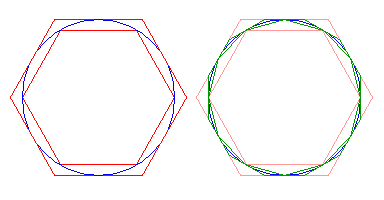
The inscribed hexagon, whose corners just touch the circle, has a perimiter equal to three times the circle's radius, giving a lower bound for pi. The circumscribed hexagon gives an upper bound for pi, which equals 3/cos(30°), or 3.4641... and then both of these hexagons can be used as the starting point for drawing a twelve-sided regular dodecagon, which will be considerably more like the circle it is touching either on the outside or the inside, thus giving closer bounds to pi. And then the process can be repeated, giving polygons of 24, 48, and 96 sides.
Many years later, also using polygons and geometry, Ludolph van Ceulen calculated the value of pi to 34 decimal places. Numerous references state that because of this, pi became generally known as the Ludolphine Number (Ludolphische Zahl) in Germany; thus, for example, it appeared in the title of an 1885 paper by Weierstrass; however, that term was most popular prior to 1910, and was much less common in Germany in the postwar era.
This method of calculating pi was difficult, but at first it was the only valid mathematical method known. Eventually, as a consequence of the development of calculus, it became understood how to easily develop Taylor series for the various elementary functions, but the arctangent series, which we will see on the next page, was developed before the invention of calculus.
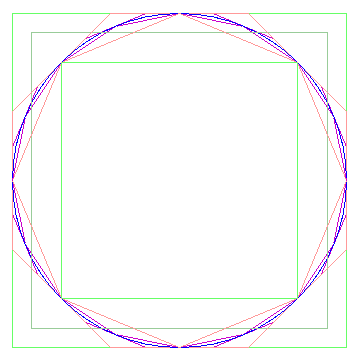
The earliest mathematical formula for pi was that derived from how it might be calculated geometrically with polygons (starting from a square, rather than from a hexagon as Archimedes did) by François Viète:
               2                2                          2
 pi  = 2 * --------- * ------------------- * ----------------------------- * ...
            sqrt(2)     sqrt(2 + sqrt(2))     sqrt(2 + sqrt(2 + sqrt(2)))
The area of a circle is, as we saw on the first page, pi times the square of the radius. So if one starts with a circle having an area of pi, and therefore a radius of one, the circumscribed square will have a side of 2, and an area of 4.
The inscribed square will have a diagonal of 2, so its sides will be sqrt(2), and its area will be 2.
Multiplying that area by 2/sqrt(2) gives the area of the inscribed octagon.
And multiplying the area of the inscribed octagon by 2/sqrt(2 + sqrt(2)) gives the area of the inscribed 16-sided polygon, and so on.
This formula can be derived from the half-angle formula.
The cosine of 45 degrees is sqrt(2)/2.
For angles in the range of interest,
     /  x  \          /  1 + cos(x)  \
cos |  ---  | = sqrt |  ------------  |
     \  2  /          \      2       /
Why is this true? Using the following diagram:
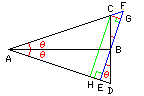
we begin with the right triangle ABC, and make a right triangle below it, ABD, which has the same shape, only reflected. Thus, angle CAB is the same as angle DAB, and so angle DAC is an angle twice as large.
The cosine of angle CAB is the ratio of the length of the line segment AB to the length of the line segment AC.
Thus, by going from point B in a direction perpendicular to the line AD, if the length of line segment AC is taken as one, then the line segment AB will have cos(theta) as its length, and the line segment AE, where AEB is a right angle, will have (cos(theta))^2) as its length.
Extending the line segment EB to where it intersects the line AC, we are able to draw a right triangle with 2 * theta as one of its angles. Thus, the cosine of 2 * theta is the ratio of the length of the line segment AF to the length of the line segment AE. We know how long the line segment AE is.
And we know that the length of line segment AC is 1. However, angle FCG is 2 * theta, so to determine the length of line segment CF, we would have to use the value we are trying to find.
All is not lost. If we drraw a line from point C parallel to the line with the points F, G, B, and E, it intersects line segment AD at the point H.
The length of line segment AC is 1. The length of line segment AB is cos(theta).
We also know that the length of line segment BC is sin(theta).
Angle CGB is also theta, and the triangle BGC is a right triangle. So the length of the line segment CG is sin(theta) * sin(theta), or sin(theta)^2.
Therefore, cos(2*theta) = (cos(theta)^2 - sin(theta)^2)/1.
From the Pythagorean theorem, cos(theta)^2 + sin(theta)^2 = 1, so we can express sin(theta)^2 in terms of cos(theta)^2, thus deriving the relation cos(2*theta) = (2 * (cos(theta)^2)) - 1.
Since we want a half-angle formula instead of a double-angle formula, we then have to turn it inside out:
      cos(2*theta)         = (2 * (cos(theta)^2)) - 1
      cos(2*theta) + 1     =  2 * (cos(theta)^2)
     (cos(2*theta) + 1)/2  =       cos(theta)^2
sqrt((cos(2*theta) + 1)/2) =       cos(theta)
which is just the formula we saw above, as long as theta happens to be half of x, which can be stipulated "without loss of generality" as mathematicians say.
Therefore, the cosine of 22 1/2 degrees will be:
      /      sqrt(2)  \
     |  1 + ---------  |
sqrt |          2      |
     | --------------- |
      \       2       /
And the cosine of 11 1/4 degrees will be:
      /           /      sqrt(2)  \  \
     |           |  1 + ---------  |  |
     |  1 + sqrt |          2      |  |
sqrt |           | --------------- |  |
     |            \       2       /   |
     | ------------------------------ |
      \               2              /
And so on.