First, let's start with the most basic facts about pi, so that we can get started on a solid foundation.
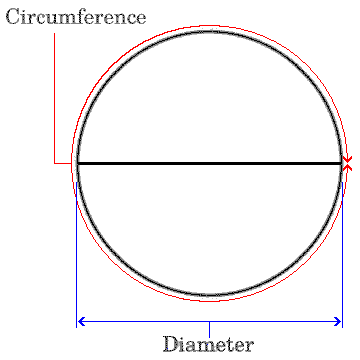
The definition of pi is the ratio of the circumference of a circle to its diameter. The circumference of a circle is the length of the curved line which constitutes the circle itself, and the diameter of a circle is how wide it is at its widest part. Since circles are round, and thus the same in all directions, it's also how high it is at its tallest part, and so on for any direction.
Pi is also used for calculating the area of a circle, the area of the surface of a sphere, and the volume of a sphere.
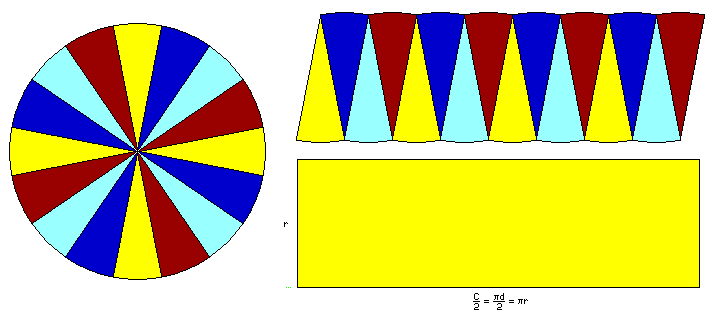
The diagram above is an attempt to justify the formula for the area of a circle, A = pi * r^2. This kind of diagram can be found in many mathematics textbooks, and one was included in a book by Sato Moshun, in Japan, in 1698; also, an illustration of the same idea appears in the Notebooks of Leonardo da Vinci.
Basically, one can cut the circle into more and more slices, and as one does so, the shape that can be built by rearranging those slices gets closer and closer to a rectangle with the radius of the circle as its height, and half the circumference of the circle as its width.
This made ancient diagrams like this particularly notable, since the idea of a limit of an estimate of the area of a shape by cutting it into smaller and smaller pieces is a basic idea that led to the integral calculus.
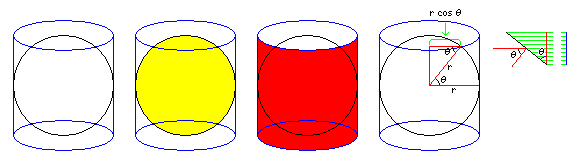
It was Archimedes of Syracuse who found that the surface area of a sphere is the same as that of the curved surface of a cylinder with the same diameter and the same height - just the curved surface, not including the flat top and bottom.
Why this is the case is illustrated by the diagram: the cosine of the angle theta both determines the size of a circle at a given height of the sphere, and the amount vertical distances on the sphere's surface are foreshortened when projected on the surrounding circle.
This is the basis, incidentally, of an equal-area cylindrical map projection, which I describe on this page.
So, since the surface of the cylinder can be unrolled into a rectangle with a height equal to the sphere's diameter, and a width equal to the sphere's circumference, the surface area of a sphere is equal to pi * d^2, or 4 * pi * r^2.
Just as a circle can be cut into many tiny pie wedges, a sphere can be thought of as many tiny little pyramids, with a height equal to the radius of the sphere, and the bases of which total in area to the surface area of the sphere.
This would tell us the volume of a sphere, now that we know the formula for the surface area of a sphere, if we knew how to calculate the volume of a pyramid.
The volume of a pyramid is one-third of the area of its base times its height.
So the volume of a sphere is (4/3) * pi * r^3.
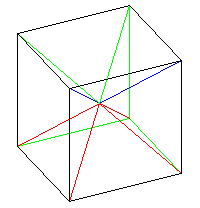
Why the volume of a pyramid is exactly one-third of the product of its base and height can be illustrated the most simply by the diagram above. A cube has six faces, as anyone who has ever played a game with (conventional!) dice knows: and its volume can be divided into six pyramids, with bases having an area equal to the side of the cube squared, and a height equal to half the height of the cube.
And, of course, one-sixth is one-half of one-third.