This section of the site deals with topics related primarily to the calendar, but also to some extent to timekeeping in general.
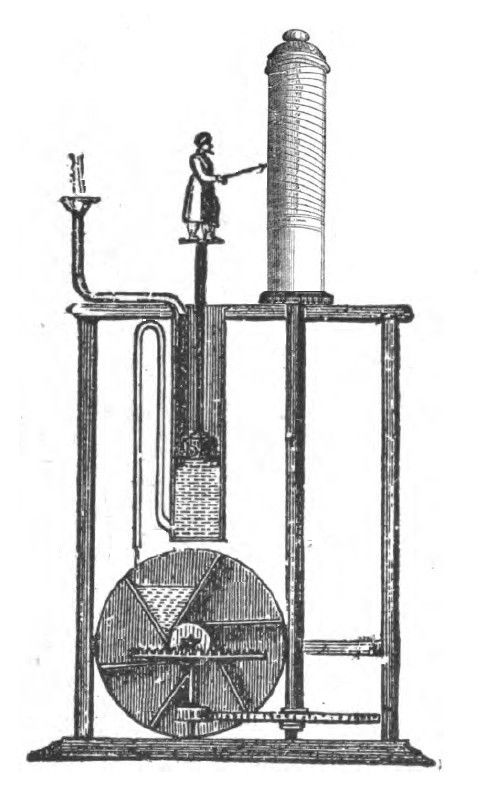
On the right, mashed together from two old drawings, neither of which satisfied me by itself, is an illustration of the design of an ancient water clock designed by Ctesibius.
The mechanism of the clock causes the pointer, held by a sculptured figure, to descend at a uniform rate during the course of a day.
The pointer indicates the hour on a cylinder which rotates once a year. The scale on that cylinder reflects the change in the time of sunrise and sunset in the course of a year, so that it indicates the hour according to civil time, which divides the time from sunrise to sunset into twelve equal hours, and that from sunset to sunrise into another twelve equal hours.
This seems perverse from our modern point of view, which sees the uniform time as given by a uniform flow of water, or a pendulum, or a quartz oscillator, as reflecting the true nature of time. However, this type of mechanical water clock was very expensive; only kings could have such clocks, and everyone else needed to make do with sundials. And so it was entirely reasonable to design the clock so that it would indicate the hours that everyone else was actually using.
Perpetual Calendars: This page includes three perpetual calendars for both the Julian and Gregorian calendars, one showing the position of each day in the week, and the other two relating to weeks of 12 and 10 days, for the Chinese sexagesimal cycle of days.
A Luni-Solar Calendar: This page contains a description of an elaborate calendar with lunar months that also follows the seasons by inserting an extra month now and then. It alternates Metonic cycles of nineteen years with seven extra months with occasional cycles of eleven years with four extra months in an intricate pattern to follow the tropical year with high accuracy.
A Simplified Calendar: This page describes a simplified calendar proposal, where all regular years, and all leap years are identical. Unlike the World Calendar, however, this calendar proposal maintains the seven-day week as inviolate, thus avoiding conflict with more conservative religious faiths.
Finding the Julian Day: This page deals with converting from the Gregorian and Julian calendars to Julian Day Numbers.
A Martian Calendar: This page talks about the questions of setting up a timekeeping system for Mars.
A Modest Proposal for the Abolition of the Leap Second: This page talks about time standards, and an alternative to a controversial recent plan to change them.
Happy Easter: Extensions to the page on the Julian Day and the page on Perpetual Calendars made it reasonable to discuss the computation of Easter as well.
Happy Hanukkah: if I can examine the complexities of Easter, then I can also go even further, and investigate those of the Jewish calendar.
The Mayan Calendar: While this calendar lent itself to discussion in connection with perpetual calendars and with Julian Day numbers, there was enough to say about it that what had become a rather long digression on the latter of the two aformentioned pages needed to be given a page of its own.