The game of Cribbage, of course, was invented in England, not Canada.
It was invented by one Sir John Suckling, who was a colorful character, some time in the early 1600s. It derived from an earlier game, "Noddy", which was similar, but differed in three respects: there was no crib, 25 was also a scoring value, in addition to 15 and 31, and these values, instead of scoring two points, scored as many points as there were cards that added to that total.
In addition to Cribbage, another game was derived from Noddy, the game of "Costly Colours". In that game, points could also be scored during pegging for several cards in a row of the same color or of the same suit.
Cribbage, requiring only relatively simple equipment to play, and being among the familiar and standard card games the rules of which are recorded in many books about popular games, is a game offering challenge and interest that has provided many hours of entertaining game play to people whose options for recreation may have been limited, such as the elderly.
A game of Cribbage begins with someone shuffling a 52-card deck of cards. Players then cut for deal. The player who cuts the lowest card wins and becomes the dealer.
The dealer then shuffles the cards and deals them to the players, first to the other player and then to himself. Cribbage can also be played by three players, but I'll only deal with the basic form for two players here. Each player is dealt six cards.
Each player then looks at his or her cards, and selects four of them for his or her hand; the other two are placed in a pile of four cards, the 'crib', which belongs to the dealer. These cards remain face down until the play of the hand is over.
Then the player other than the dealer cuts the deck. The dealer takes the card that is exposed and places it at the top of the deck, face up. If that card is a Jack, the dealer scores 2 points.
Aces are low, and count as 1. All face cards count as 10.
Each player, starting with the player other than the dealer, attempts to play a card, alternating turns.
A player must play a card on his turn if he can, even if it is to his disadvantage. Cards can be played up until their total reaches 31. A player who cannot play a card indicates this by saying "Go", and then the turn passes to the other player. After both players have said "Go", then play continues with a new running total.
During play, which is called "pegging", points are scored as follows:
Points are usually recorded with the aid of a cribbage board. This is a set of three parallel tracks of 120 holes, plus one hole after the finish line, and two storage holes before each track starts. Each player has two pegs. To help reduce errors in recording scores, when a player adds points to his score, he leaves the peg in the hole corresponding to his current score untouched, and moves the other peg to the hole corresponding to the new score.
The first player to reach 121 points is the winner of the game. If the other player has not yet passed 90 points, it is a "skunk", which counts as winning one and a half games in a series of games, and if the other player has not yet passed 60 points, it is a "double skunk" which counts as winning two games.
After the players have played all the cards in their hands, they gather their hands back together. The player other than the dealer counts and pegs the value of his hand first. The card cut by the other player and placed on top of the deck by the dealer is treated as though it is a part of each player's hand.
Points are scored through each player finding in his hand the same combinations of cards as scored points in pegging, except that cards which total to 31 do not count, and a Jack in the hand that is of the same suit as the face-up card at the top of the deck counts one point. Also, if all the cards in the hand are of the same suit, 4 points are scored; in the case that the face-up card is also of the same suit, 5 points are scored instead. However, this does not apply to the crib: for the crib, 5 points are scored if all the cards in the crib and the face-up card are of the same suit, but no points are scored if only the four cards in the crib are of the same suit.
The dealer, after he counts the points from his hand, then also counts points from the 'crib' in the same way as the hands were counted, including counting the extra face-up card.
Note that as there are three ways to choose two cards from three, and six ways to choose two cards from four, the scoring of 2 points for a pair, 6 points for three of a kind, and 12 points for four of a kind reflects this, granting 2 points for every possible pair.
Counting the value of a hand is made easier and more rapid by remembering the values of certain commonly encountered high-scoring combinations of cards.
If a player has a hand such as 2 3 3 4, this is called a "double run"; the runs of 2, 3, 4 with each of the 3 cards both count for 3 points, and as well, the pair of threes counts for an additional 2 points, for a total of 8 points.
This can be improved if the face-up card fits into the hand; if the face-up card were another 3, the hand would be a "triple run", scoring 15 points; if it were a 2, the hand would be a "double double run", scoring 16 points.
And if the face-up card were an Ace, the hand would be a "double run of four", for 10 points.
Of course, such a hand could also have fifteens in it, adding to the score.
Thus, 4 5 5 6 would be counted as "fifteen two, fifteen four, and eight is twelve", scoring 12 points; if the face-up card were another 5, there would be three fifteens, for 6 points, and a triple run for 15 points, for a total of 21 points; if the face-up card were a 4 (or, of course, a 6) there would be four fifteens, for 8 points, and a double double run for 16 points, for a total of 24 points.
And if a player were to have a hand consisting of four fives, then there would be four possible ways to make a fifteen, and so eight points for that, plus twelve points for four of a kind would make 20 points. Were a 10 or a face card to turn up as the face-up card, the score would be 28 points, as an additional four fifteens would be added.
The ultimate hand in Cribbage is when a player holds three fives in his hand, and a Jack that is of the suit not represented in those fives, and then the fourth five turns up as the face-up card. Then, the player will score one additional point for "his nibs" in addition to 28 points for four fives and a ten-count card. This is the only kind of hand that scores this much, and no hand exists that scores more.
This page is about Cribbage, which was invented in England. Yet it is titled "A Canadian Invention". Well, here we are; now I shall talk about the thing that was invented in Canada. And that thing was:
One of the most popular styles of cribbage board used to play the game.
When counting a hand of Cribbage, the maximum possible score for the hand is 29 points. This is achieved when a five is the face-up card, and the player holds the other three fives in his hand, along with a Jack of the same suit as the face-up card.
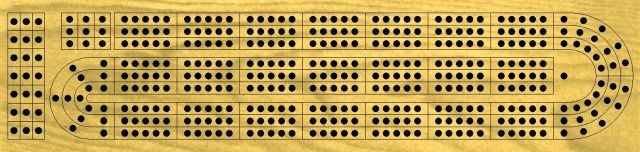
Ordinary Cribbage boards simply divide the tracks of holes into which the pegs are placed into three rows, connected by semi-circular portions of the path. The normal scheme for such a board is shown below:
This diagram is based on the layout of an actual plain Cribbage board. Note that before the start of the track proper, there are three, rather than two, rows of holes. While only two sets of pegs are needed for actual play, three are usually supplied with Cribbage boards, partly to protect against losses, but also because, as noted below, a peg can be used in an auxilliary small track to keep track of games won.
Then there is a small track of seven rows of holes on the left in the illustration. This is used to record games won, and no doubt serves to explain why there were three, rather than just two, rows of holes before the start of the track, because the third peg is being put to use there.
Here is an actual photo of a cribbage board of this basic type:
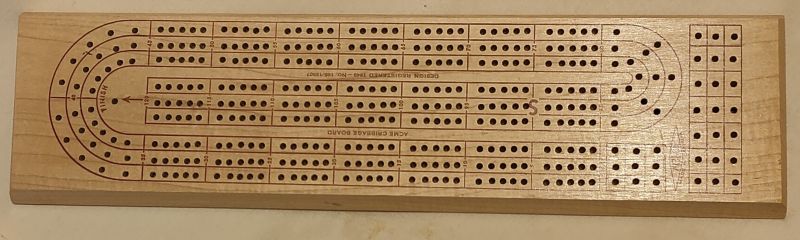
Note that this is a genuine Acme cribbage board.
The decorative type of Cribbage board of which I speak instead forms the paths into the shape of the digits in the number 29.
This was first invented in Burnaby, British Columbia, by one Edward M. Hirst, some time in the early 1950s. Woodworking was his hobby, and he was left paralyzed by poliomyelitis. After inventing this type of Cribbage board, he made them by hand and sold them up until he passed away in 1960.
While my source for this information merely speculated that he must have registered his design, as unauthorized imitations did not start appearing for quite some time, I was able to actually locate the design registration, on the Canadian Industrial Designs Database. The registration was applied for on March 12, 1956, and the registration, number 20554, was granted on June 4, 1956.
In 1962, boards in this type, called the 'Mister "29" Cribbage Board' began to be distributed by Ryco Sales to retailers. This continued for many years thereafter, although in later years, the 'Mister "29"' trademark was dropped, and the board was instead sold as "The Perfect Cribbage Board". The actual manufacturer of those boards is, apparently, unknown. An unusual characteristic of these wooden Cribbage boards is that they were quite thick, as instead of just having a pocket on the bottom with a sliding door for the pegs, it had a larger pocket with two compartments; one for the pegs, and the other one for a deck of cards.
And it is because one of these has come into my possession, through a fortunate purchase at a thrift shop:
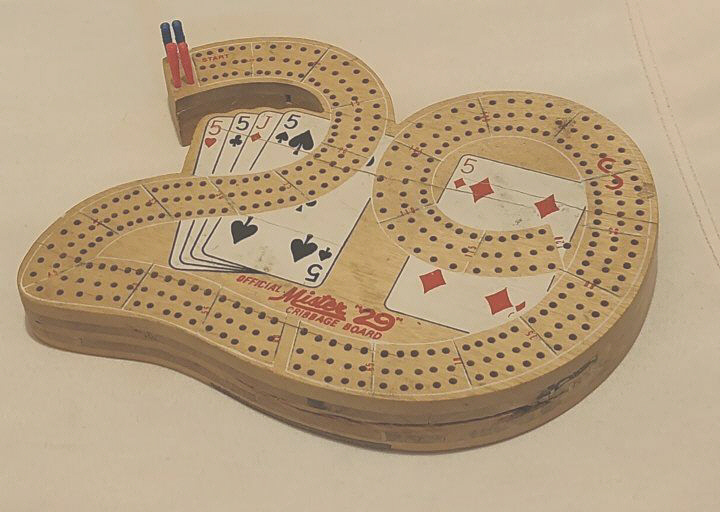
admittedly a badly-cracked specimen, that I have felt motivated to write this page. (The pegs are not original; they're from a set of plastic replacement Cribbage pegs in current production, sold at dollar stores.)
Sommerville Industries, a major Canadian board game manufacturer, began in 1964 to make a less expensive plastic Cribbage board in this style, and they included a slip of paper with it mentioning the story of Edward M. Hirst, in addition to the usual small booklet explaining the rules of the game.
It had only a peg compartment, but presumably because the board was plastic, the aluminum door rotated to open rather than sliding out.
One of these boards was the first Cribbage board my mother purchased after we moved to Edmonton, and we played Cribbage on that board for many years.
This part of the story, though, may actually be more complicated than I had realized, because I have found plastic cribbage boards with 'Mister "29"' branding offered for sale, some of which were almost identical to the ones sold independently by Somerville. So they may also have been a supplier to Ryco Sales at one point.
Today, thinner wooden boards in the 29 style, but with only the usual peg compartment, are made and sold by numerous companies.
I must thank this page on the site of the American Cribbage Congress for making me aware of the facts of the history of the 29 style of Cribbage board.
A friend of mine had gotten a large board for playing a variant of Cribbage; a longer board with various penalties. The game was called Crib Wars.
Recently, I had seen this game brought out by several different companies, and I was wondering how this could be; the game was obviously of recent origin, and certainly it would be proprietary.
Well, I found the United States design patent for it; it was design patent number 420,399 and as its term was 14 years, and it was granted on February 8, 2000, that patent had now expired.
And the designers? Norman Ackland and Robert Prettie, both of London, Ontario, Canada.
Copyright (c) 2026 John J. G. Savard