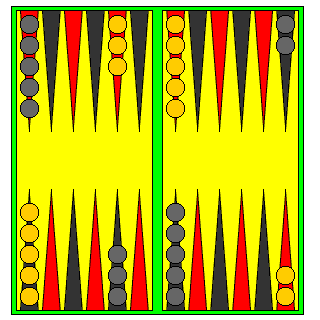
Although sometimes it is claimed that Chess or Checkers has the greatest antiquity of all board games, it is now known that the board games found in ancient Egypt and Mesopotamia are instead closely related to this modern board game:
The game, of course, is Backgammon, and the illustration above shows the board and the initial arrangement of the men.
One off-putting thing about the traditional Backgammon board is that it is not clear where the board begins or ends. For the board as illustrated, the player with the light pieces moves in this direction:
      1 1 1 1 1 1   1 2 2 2 2 2
  --> 3 4 5 6 7 8   9 0 1 2 3 4
 |
 |
  --- 1 1 1
      2 1 0 9 8 7   6 5 4 3 2 1
and the player with the dark pieces moves in this direction:
      1 1 1
  --- 2 1 0 9 8 7   6 5 4 3 2 1
 |
 |
  --> 1 1 1 1 1 1   1 2 2 2 2 2
      3 4 5 6 7 8   9 0 1 2 3 4
The dividing line between the two halves of the board is called the bar, and represents the space before space 1 for each player.
The rules of Backgammon, as it is played today, are:
On each turn, a player rolls a pair of dice to move. The numbers on each of the two dice indicate individual moves, thus, a player may move two pieces in a turn, one by one of the numbers on the two dice, the other by the other number on the two dice. If one piece is moved, that piece must be able to stop on the intermediate space (or point) resulting from making the move indicated by one of the two dice.
If doubles are rolled, the player has four moves, rather than two, to make using the number shown on the two dice.
It is not possible to move one of one's own pieces to a point with two or more of the opponent's men on it.
It is possible to move one of one's own men to a point with only one of the opponent's men on it; this sends that man to the bar.
If any of one's own men are on the bar, all these men must be moved off the bar before any part of a dice roll may be used for any other type of move. However, once one has moved one's last man off of the bar, the remaining unused portion of the dice roll for that turn may then be used for other moves.
The object of the game is to move all one's men home, where home can be thought of as the 25th square of the board for each player. Moving men home is called bearing off, and is subject to the special rule that no man can be borne off unless all of one's men are in the last six points of the board.
When the player that has lost the game has not borne off any of his own men, this is gammon, and counts as a double loss.
As for backgammon, which counts as a triple loss, the current official rule, which dates back to the official backgammon rules of 1931 (which also introduced the doubling cube) is that backgammon is scored against a player if, in addition to not having borne off any of his own men, he also has at least one man in the first six spaces of the board, or on the bar.
In older game books, instead, backgammon is scored against a player when, in addition to not having borne off any of his own men, all fifteen of his men are on the opponent's half of the board (note that this requires, at the least, that the eight men whose starting positions were on his own side of the board all have been sent back to the bar).
No part of a roll may be discarded if it can be played, even if to do so is disadvantageous.
Initially, the value of a game is one point, or two if gammon, three if backgammon. Either player, if he feels himself ahead, may take the doubling cube, and present it to the other player in the position marked "2". The other player then has the choice of conceding the game at its old value, or accepting the doubling of the value of the game.
After the first double, only the opponent of the player who made the last most recent double may double; thus, each time one doubles, one gives the other player control of the doubling cube.
Doubling was added to backgammon during or before 1926, although the doubling cube was not used as the means of keeping track of doubles until 1931, as noted on this page. A game played on the backgammon board in the seventeenth century, called Ticktack, which was a close relative of Trictrac, had a similar doubling rule, except that the stake was increased by one point each time rather than doubled, but the game was only recently rediscovered from a suriving manuscript. This is discussed on this page.
Another page on that site leads to descriptions of many variants of Backgammon.
Because people have been playing Backgammon for a long time, it has been possible to work out what are the best moves to make for the first player in response to all twenty-one possibilities for the first roll of the dice. The list given here comes from a nineteenth-century edition of Hoyle's Games. These will illustrate some of the principles of good play in Backgammon.
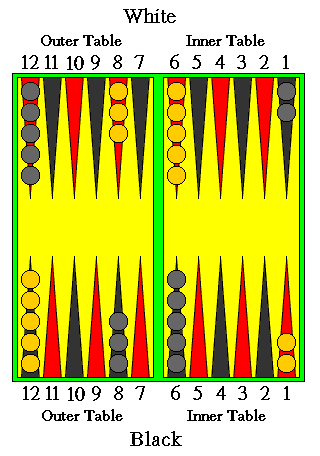
Of course, in order to list these moves, it will be necessary to have a way to describe moves in Backgammon. The diagram above shows how this is done: Black's one point to Black's six point are in Black's inner table, Black's seven point to Black's twelve point are in Black's outer table, and the same applies to White.
As an example of the compact notation I will be using below for the moves, the recommended move for a roll of two sixes is to move the two men on your opponent's 1 point to your opponent's 7 point (also called the bar point), and two of the men on your opponent's 12 point to your own 7 point.
I will note that move below as:
2x*1-*7, 2x*12-7
where the asterisk before a number indicates that the point the number of which is given is on one's opponent's side of the board, and when two men make the same move, the move is preceded by "2x" (and "3x" and "4x" similarly indicate three or four men making a particular move).
For some of the initial rolls, a different move is noted as best for situations where one does not wish to gamble on getting a gammon, but simply wishes to maximize one's chances of at least winning. These are noted in the alternate move column; when such a move is present, G instead of W, G is in the Goal column, to indicate that the first move given is only applicable if the goal is to play for a Gammon, although no alternate move is given for the case of a roll of 3-2.
| Roll | Move | Goal | Alternate Move |
| 1-1 | 2x8-7, 2x6-5 | W, G | - |
| 6-6 | 2x*1-*7, 2x*12-7 | W, G | - |
| 3-3 | 2x6-3, 2x8-5 | G | 2x*1-*4, 2x8-5 |
| 2-2 | 2x6-4, 2x*12-11 | G | 2x*1-*3, 2x6-4 |
| 4-4 | 2x*12-5 | G | 2x*1-*5, 2x*12-9 |
| 5-5 | 2x*12-3 | W, G | - |
| 6-1 | 8-7, *12-7 | W, G | - |
| 6-2 | *12-5 | W, G | - |
| 6-3 | *1-*10 | W, G | - |
| 6-4 | *1-*11 | W, G | - |
| 6-5 | *1-*12 | W, G | - |
| 5-4 | *1-*10 | W, G | - |
| 5-3 | 6-3, 8-3 | W, G | - |
| 5-2 | *12-8, *12-11 | W, G | - |
| 5-1 | 6-5, *12-8 | G | *1-*2, *12-8 |
| 4-3 | *12-9, *12-10 | W, G | - |
| 4-2 | 6-4, 8-4 | W, G | - |
| 4-1 | 6-5, *12-9 | G | *12-9, *1-*2 |
| 3-2 | *12-10, *12-11 | G | - |
| 3-1 | 6-5, 8-5 | W, G | - |
| 2-1 | 6-5, *12-11 | G | *12-11, *1-*2 |
One important element in playing Backgammon is to be able to accurately figure the odds of various dice rolls.
If one has to leave an isolated man, or blot, on the board, subject to being sent back to the bar, it is useful to know how much risk is involved in leaving such a man on a given space. Thus, the following table shows the number of possibilities, out of thirty-six, that a roll of the dice will allow a man to be moved a certain number of spaces:
 1  11            11
 2  11       1    12
 3  11   2   1    14
 4  11   2   2    15
 5  11   4        15
 6  11   4   2    17
 7       6         6
 8       4   2     6
 9       4   1     5
10       2   1     3
11       2         2
12           3     3
15           1     1
16           1     1
20           1     1
24           1     1
The first column shows the number of spaces to be moved; the second, the chances that the number will appear on one die; the third, the chances that it will be possible for that number to be formed as the total of the dice for a roll other than one of doubles; the fourth, the chances that, in the case of a roll of doubles, it will be possible to form the number from two, three, or four copies of the number on the face of each die; and the fifth, the total of all these chances for making a move of a given length.
Thus, the probability is 17/36, just 1/36 less than one-half, that if one has a blot that is six spaces in front of an opponent's man, that your opponent's next roll will enable him to hit your man.
That is because there are: eleven chances of a roll in which one or both of the dice show a six, two chances each of 1-6, 2-6, 3-6, 4-6, and 5-6; four chances of a roll other than a roll of doubles where the total of the dice is six, two chances each of 1-5 and 2-4; and two chances of a roll of doubles where a move of six spaces may be made from more than one die (6-6 already having been counted in the first column), one chance each of 2-2 and 3-3.
Of course, a blot you may be considering leaving is likely to be reachable by two or more of your opponent's men in different positions. To determine the probability of that, it is necessary to consider the overlap between the dice rolls which allow movement by the different distances involved. Showing how the probability is divided between different types of roll in the three columns of the table above may help somewhat with that.
This variant of Backgammon was played in the armed forces. It varied from regular backgammon in that a player who rolled doubles, in addition to counting the dice twice, also got a free turn. As well, a roll of 1-2 allowed the player to play a double of his choice in addition to that roll, and to also get a free turn. The 1-2 roll had to be played before the double.
All pieces start off the board in this game, and all of a player's pieces must be on the board before that player's pieces on the board can be moved.
The ancient Romans played a game very similar to Backgammon, which was called Tabula.
As in Backgammon, both players have fifteen pieces; however, all of them start off the board.
Until all one's pieces are entered, it is not permitted to move past the first half of the board.
Both players move in the same direction.
Three dice are thrown for each turn, and the numbers on them are always what is played.
As in backgammon, all one's pieces have to be in the last six spaces before bearing off can commence. The same rules apply of being able to send an enemy singleton back to the start, and that a piece so sent must be reentered before any other move is made, apply as in Backgammon, as does the rule that one cannot move a man to a space occupied by two or more of the opponent's pieces, and the rule that the whole roll must always be played if possible.
This game was played with three dice on a board with three rows of twelve spaces. The rules have not survived, but it was likely played with rules very similar to those of Tabula.
Here is a game of my own invention, based on modern backgammon, and not intended to be a plausible reconstruction of Ludus Duodecim Scriptora, but still sharing its general features of having three rows of spaces and using three dice:
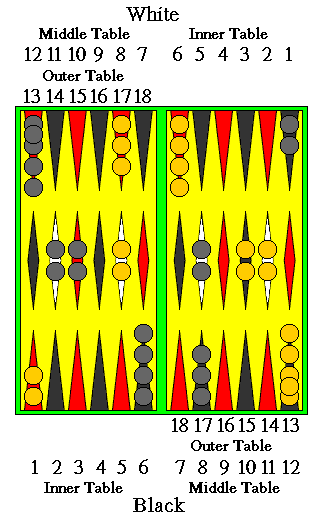
Each player starts with 20 men, placed as shown in the diagram. Movement is along an S-shaped path, from spaces 1 through 18 in the opponent's tables and then from spaces 18 to 1 in one's own tables.
Since men may be stacked as well as laid out in a row, the center space between the points is sufficient to serve as a third row of points, so that a regular Backgammon board can be used if players take care about the location of their pieces. Of course, a special board is still to be preferred.
When the three dice are thrown, whether they are all different or two of them are the same, the numbers are simply played as they turn up; but if a player rolls a triple, with all three numbers the same, then they are played as though four dice had been cast with that number turning up.
This smaller bonus (four numbers instead of three, 1 1/3 times as many, instead of four numbers instead of two, twice as many) occuring one-sixth as often (once in thirty-six rolls on average instead of once in six rolls) seems to me to be reasonable to carry over from normal Backgammon as opposed to having no such bonus at all.
Otherwise, the rules are as regular Backgammon.
Note that I have drawn inspiration for the initial arrangement of the men from the recent variant Nackgammon.
And then, of course, there are the children's games that have the same basic objective of bringing all one's men home before the other player:
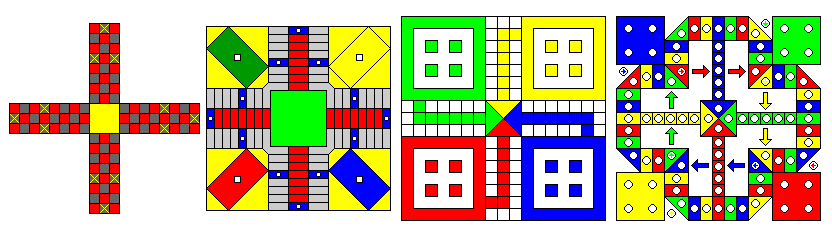
On the left, we see the original board used in India for both the game of Pachisi and the game of Chausar.
In both these games, the pieces start from the central home square, and then go around the board in a clockwise direction. When the pieces are finally on their way home, they are flipped over to show that they are entitled to move towards home and not away from it on the final path.
In Pachisi, the move is determined by the throw of six cowries. The number of cowries that fall face up is interpreted as follows:
0 25, 1, free turn
1 10     free turn
2 2
3 3
4 4
5 5
6 6      free turn
Thus, if no cowries fall face up, the player has two moves, one of 25 squares, and one of one square, to play, either both with one man, or each move with a different piece. This is the only case in Pachisi where two men can be moved with one move as in Backgammon.
The squares marked with an X are places where pieces are safe from capture. Elsewhere, if one has two or more pieces on a square, they will both be sent back to the start if an enemy piece lands on that square afterward.
In Chausar, players roll three dice to move their men. The dice are four-sided, usually being marked 1, 3, 4, and 6, although sometimes dice marked 1, 2, 5, and 6 are used instead.
Once pieces attain the third leg of the board, the one they started from being the first, they can combine to form a double piece; a double piece is immune from being sent back by any single piece, but can still be sent back to the start by an opponent's double piece.
The three numbers produced by the roll of the dice are used to move the men, and as in Backgammon they can be used on the same man or two or three different ones.
In Chausar, the squares marked with an X do not provide immunity from capture. Also, when four players are playing, they play as partners, and one of the two players in a partnership must send all his men home before the other player can send any men home.
Chausar is felt to be as profound as Backgammon, as opposed to Pachisi which is a simpler game.
The next board is one example of a Western version of Pachisi played with one ordinary die. Movement is also clockwise; pieces are placed on the board on the blue space just after the one at the approach to the private passage to the home square. A roll of 5 is required to place a piece on the board from the home area.
The original version was played with two dice; here, a five on either die or a total of five is used to put a piece into play, and a roll of doubles gives a free turn. The third double in a row is not played, and one must put one's man nearest home back to home.
The blue spaces give immunity to being sent home.
The original version of Pachisi introduced to the West was from Chaffee and Selchow (the predecessor of Selchow and Righter), which trademarked the name Parcheesi, under which the game was best known. Many other versions were available, as the game was very popular, under names such as Pa-chiz-si and Chessindia. As well, there are many other race games of this general type, such as Trouble, Aggravation, and Sorry! which have been successful as well.
The third board is an example of a board for the game of Ludo. This is a somewhat more generic race game, as it lacks the safety zones or castles, and movement is now in the more conventional clockwise direction.
The players roll one die to play Ludo. In this game, one rolls a 6 to bring a man out from the starting area to the entrance square on the board. A roll of 6 also provides one with a free turn, whether it is used to start a man or move six spaces, but if one rolls a six on one's second free turn of this nature, making it the third in a row, then not only does one not get another free turn, but also one does not move a man six spaces from that roll.
The last board is one that I first saw in a small set of multiple games made in Hong Kong. There, the game was billed as Ludo. However, it is in fact a different game of Chinese origin, Fei Hsing Ch'i (Fei Xing Qi), with aviation as its theme.
With this game, a six again is used to start a man out, and gives a free turn. But in this game, a third six causes any men moved by the previous two sixes to be sent back to the starting area.
Landing on a square of one's own color entitles a man to advance to the next such square, except in the case of the shortcut paths that allow a longer advance.
Another traditional game of this type, apparently closely related to Pachisi, is the traditional Korean game of Nyout.
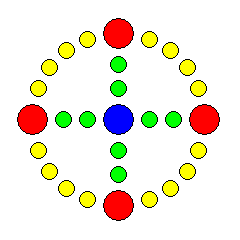
Movement is counterclockwise. Pieces enter the board on the small circle on the outer perimiter (a circle of the type shown in yellow on the diagram above) immediately clockwise from the large red circle which is associated with the player that controls them. When they reach that red circle, they proceed down the path (green) leading to the central home circle (blue).
Moves are determined by the throw of four sticks, with a white side and a black side. The number of spaces to move follows from the number of black sides up as follows:
4 black sides     4 spaces
3 black sides     3 spaces
2 black sides     2 spaces
1 black sides     1 spaces
No black sides    5 spaces
Having either four black sides up or four white sides up gives an extra die roll, but this is not a separate turn; instead, the number of spaces to move is determined from all the rolls so made before a man is moved.
There are some important differences in the rules between this game and the games from Pachisi to Ludo above, however.
It is still true that a man is sent back to the beginning if an opponent lands on it. No special roll is required to enter a man on the board. Players can start with four men each, as in Pachisi, but this game can also be played with fewer.
One can land on one of one's own men with another man; the result is that the stack of two men can both be moved with a single die roll henceforth.
The red circle at the end of a complete circuit of the board by which one sends one's men to the home circle must be hit by exact count. If one overshoots, one can use the next red circle, even if it normally is used by an opponent.
And then there is Ashtapada. The original rules of this game are not known; my conjecture on how the men moved along the board, inspired by the path of the men in the apparently similar game of Thaayam on a 5 x 5 board, is the following:
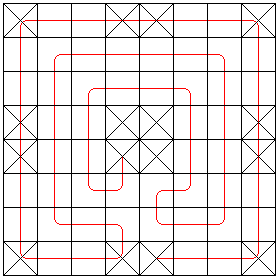
but this conjecture does not seem to be widely shared.
The board for Thayyam, and the path taken by one player, is shown below:
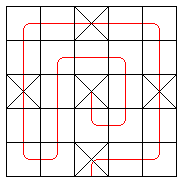
Up to four can play, and each player starts from a different one of the squares in the center of each side.
The rules are:
The moves are determined by the throw of five cowries. The number of cowries that fall with their mouths up is interpreted as follows:
0 8
1 1
2 2  end roll
3 3  end roll
4 4
5 5
Before any pieces are moved, the cowries are rolled repeatedly until a roll of 2 or 3 ends this phase.
Each player has four pieces, and all pieces start off the board. A roll of 1 is required to enter a piece on the board. As shown in the diagram, pieces enter in the space in the center of a player's side of the board; this space is called the player's palace.
Normally, all rolls made during the roll phase are available to a player for moving pieces. However, rolls made before the first 1 rolled by a player are ignored. Also, if all of a player's pieces, except those already brought to the finish, are removed from the board, then the player must again first roll a 1 before any rolls are saved to be used for movement.
The various numbers produced by the roll of the cowries can be applied to different pieces; when two or more of those numbers are applied to one piece in a single turn, that piece makes one move the length of which is the total, without stopping on any intermediate squares.
The cross-hatched squares on the board are all safety spaces, where pieces of different colors can land without disturbing each other.
If a piece lands on a plain square occupied by pieces of other players, those pieces return to their initial position off the board, to be re-entered once again.
When a player lands two pieces on the central square of the side opposite the player's own side, they may, at that player's option, be combined to become a twin. Only pairs of pieces may be combined in this way, compound pieces of three or more pieces may not be formed.
A twin moves half the number of spaces, rounded down, of the dice rolls applied to it in a turn.
A twin may only be captured and sent back to the start by another twin. A single piece, however, may land on, and share, a square that is occupied by another player's twin piece.
The square in the center of the board, called the keep, may only be entered by an exact count. In the case of a twin piece, the rolls applied to it must move it exactly to the keep, but rounding down an odd amount by one is still permitted. It is a safety space. Pieces in the keep still must move one space further, to leave the board, but this can only be done when a player has no pieces elsewhere on the board or waiting to be entered on the board. This also requires an exact count, thus only rolls of 1 are usable for bearing off: once a twin piece is moved to the keep, it is broken up into two individual pieces. The game is won by the player who is the first to bear off all four of her own pieces.
These rules can presumably be applied to the board for Ashtapada without too much difficulty. The cross-hatched corner squares can also be safety spaces, and it can be allowed to make pieces into twins on both central cross-hatched spaces opposite a player's starting point.
Of course, it is quite likely that even if Thayyam is a direct descendant of Ashtapada, the rules were changed in the intervening ages, but the orignal rules for Ashtapada are lost.
The game of Backgammon is also played in Japan, with only very slightly different rules, under the name Sugoroku.
Just as the hexagonal game inspired by Halma, and originally named Star-Halma (or, rather, Stern-Halma, as it originated in Germany) is most commonly known as Chinese Checkers, although it actually had no connection with China, at one point in the same era, Milton-Bradley introduced the game of Kakeba, styled as "Kakeba, or Japanese Backgammon".
The board looked something like this:
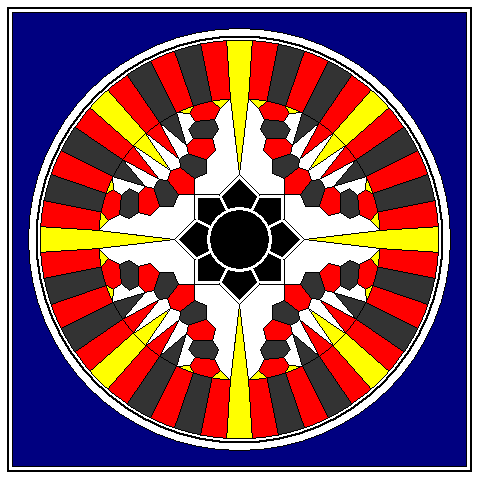
While a Backgammon board has twenty-four spaces, six each in four tables, this board has forty-eight spaces, or twice as many, in a circle. As well, there are four extra alternate paths available. As these paths are two spaces longer than the normal path on the outer circle, I presume that if the player uses these paths, presumably by landing exactly on the space by which they are entered, there is a benefit to be obtained; perhaps blots are immune to capture on the side paths.
I can only guess, just as I did for the colors of the board, as I have not been able to locate the rules on the Web as of yet.
Parcheesi is a trademark of Hasbro, and formerly of Selchow and Righter; Pa-chiz-si is a trademark of Transogram; Sorry! is a trademark of Hasbro, and formerly of Parker Brothers; Aggravation is a trademark of Hasbro, and formerly of Lakeside Industries; Trouble is a trademark of Hasbro, and formerly of Irwin Toy; Kakeba is a trademark of Hasbro, and formerly of Milton-Bradley; Chessindia is a trademark of Clark and Sowdon.