Although more detailed information than this page provides is available elsewhere on the web, as well as in print, I still felt it worthwhile to briefly discuss a few of the best-known forms of Chess. I begin by giving the rules for the standard European game, although they are very well known, so as to have them available as a starting point in describing the other forms of Chess.
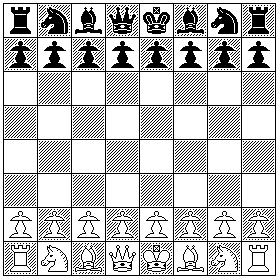
The board pictured at left is, of course, that for the standard European game of chess. The pieces for white, which always moves first, are at the bottom of the board. The array consists of one row of eight pawns in the front, and pieces in the order Rook, Knight, Bishop, Queen, King, Bishop, Knight, and Rook on the back rank.
Pawns move one space forwards, but may also move two spaces forwards on their first move. They do not capture in the normal direction of movement, but instead capture by moving one space diagonally forwards. A Pawn that reaches the opponent's back rank at the far side of the board must promote immediately, and may do so to a Queen, Rook, Bishop, or Knight. When a pawn moves two squares on its first move, on the next move, an opponent's pawn can move diagonally to the square it skipped over, capturing it as though it had only moved one space: this is en passant capture.
Rooks move and capture in a straight orthogonal line in any of the four cardinal directions, any number of spaces.
Bishops move and capture in a straight line in any diagonal direction, any number of spaces.
The Knight moves and captures so as to be displaced by two spaces in one orthogonal direction, and by one space in a perpendicular orthogonal direction. This move does not affect, nor is affected by, pieces that might seem to be intervening between its start and end.
The Queen moves and captures in the same ways as both the Rook and Bishop may do so, making either an orthogonal or diagonal move.
The King moves and captures one space in any orthogonal or diagonal direction. As its first move, if it is not threatened with capture, or crossing a space where it would be threatened with capture, it can move two spaces to the left or right, provided that no pieces intervene between it and the Rook on that side, which must also not have moved before, and which then leaps over it to the square it skipped over in its move. This is called castling.
The object of the game is checkmate, a situation where the King is liable to being captured in its present position (termed being in check) and no moves are possible except moves, whether by the King or by other pieces, that do not leave the King still liable to capture.
Stalemate, in which the King is not liable to capture in its present position, but would become so after any move that would otherwise be possible (otherwise, because it is illegal to move the King into check) is not a victory for the stalemating player, but is a draw.
The threefold repetition of the same position on the board allows the next player to claim a draw, and 50 moves without a capture or a Pawn advance allow either player to claim a draw (this rule, at one time, had an exception in certain positions where a win has been shown to be possible, but to require more than 50 moves; this exception has since been withdrawn).
The modern form of Chess originated in Europe some time after 1475; this is when the modern moves of the Bishop and the Queen were added to the game, other modern rules, specifically castling and the two-step move of the Pawn, having been added at other times. Courier Chess, which dates back to 1202, was named after a piece having the move of the modern Bishop, and it apparently predates any Great Chess version with a piece having that move, even Timur's Chess, which included the Taliah, a piece that had the move of the Bishop except that it could not move a single space diagonally, the Fers having that move.
The Taliah was doubtless an independent invention, but other forms of Great Chess which include a piece like the Bishop appear to have been derived from modern Chess. However, it certainly is also possible that a form of Great Chess derived from Shatranj could have later been modified to become an enlarged form of modern Chess instead, although most enlarged versions of Chess did not survive long enough for anything like that to happen to them.
Although Courier Chess appears to have originated in Germany, apparently that does not mean that the modern form of Chess, with the new moves of both the Bishop and the Queen, originated there. Early works about modern Chess are known from Spain, Portugal, and Italy; the earliest known work, no longer extant, was from Valencia and written in Catalan, and thus it has been suggested that this area was the birthplace of modern Chess, although the current consensus is that the place of its origin could have been in Portugal, Italy, or even France, as well as Spain.
The custom of chequering the chess board originated in Europe before the invention of the modern game; I have seen dates from 1100 to 1300 given for this innovation, however. It was not until the nineteenth century that the rule that White always plays first was adopted. However, that the White King was on the right of the White Queen, never on the left, had been the rule from the earliest days of the ancient game, so in one respect the layout of the chess board has been consistent through the ages.
Before the rule that White plays first was adopted, one rule that was followed was that while players would alternate the first move, each player would continue to play with the same color of pieces. The player not having the first move in the first game would have the choice of colors. Thus, I suppose one could imagine a match where a right-handed player was playing with the White pieces, and a left-handed player was playing with the Black pieces, so that both of them were happy: that this would be the ideal case seems to have been the thinking behind such a rule.
This is also the layout of Chaturanga, the ancestor from India of the present game of chess. In it, the piece corresponding to the Bishop, called an Elephant, moved two squares diagonally, ignoring any piece on the intervening square, and the Queen moved only one space diagonally. Stalemate was a win for the stalemating player. Pawns promoted only to Queens, and there was no double-step first move.
The King also did not castle, but it had the privilege of making a Knight move once during the game, provided that it had not yet been checked. (This is the rule in the game of chess local to India played there at present; the rules for the original Chaturanga are not entirely known with certainty. Another source notes the privilege of making a Knight move as a later innovation which took place outside of India.)
The form of chess brought to Europe through Persia and the Arab world, Shatranj allowed the King to switch places with another piece on its side not en prise when stalemated.
Many variations of the rules of Chaturanga and Shatranj existed; for example, in some, stalemate was a loss for the stalemating player. According to one account I've read, originally in India, stalemating the opponent was a win, but then it was changed to a loss, at least in some parts of India, and then stalemate became a draw in Persia. However, that did not mean that the modern stalemate rule was in effect from then on; much later, in Europe, stalemate was a half-win in Spain, a loss in France, and a draw in England, at least for the modern game of chess.
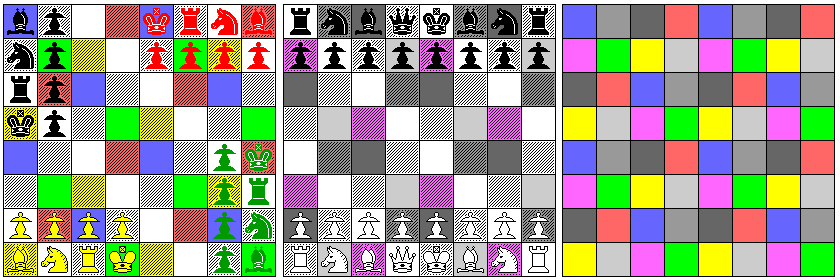
Also, there was a four-player form of Chaturanga, with the following initial setup:
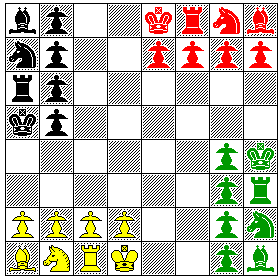
Some sources use the name Chaturanga only for the four-player game, and Shatranj for the two-player game. As Shatranj is a Persian word, however, there must have been an Indian name for the two-player game as played there before it spread to other countries.
These sources also state that Chaturaji is the name for the four-player game when it is played with dice, Chaturanga being the four-player game without dice. More recent sources, however, state that Chaturaji is the four-player game, whether or not dice are used, and Chaturanga the two-player game. (This is a reasonable conclusion from the meanings of the two names in Sanskrit: Chaturanga is the game of the four elements of an armed force, the foot-soldiers, chariots, horses, and war elephants, while Chaturaji is the game of the four Kings.)
When the four-player game of Chaturaji is played with dice, the dice are usually four-sided dice with the numbers from 2 to 5 on them, although six-sided dice can also be used. The dice indicate which pieces can be played as follows:
2 (6) Bishop
3     Knight
4     Rook
5 (1) King or Pawn
Thus, if six-sided dice are used, a roll of 1 is treated as a roll of 5, and a roll of 6 is treated as a roll of 2.
When Chaturanga, the two-player game, is played with dice, the rolls for the Bishop and Rook are switched just as the names of the pieces were, but, in addition, as the Queen is now included, six-sided dice are needed, and the meanings of the rolls become:
1 Pawn
2 Rook
3 Knight
4 Bishop
5 Queen
6 King
In this game, the four players' turns are in order counterclockwise. Diagonally opposite players are partners.
The pieces shown as Bishops are actually Alfils; they move two spaces diagonally, ignoring intervening pieces. As they cannot capture each other, there is a special rule: the piece completing a square of four of these pieces captures the three others.
Pawns do not have a two-step first move.
Pawns can only promote if at least two of the other pawns of the same color have been captured. If two others have been captured, they may promote either to a Knight or a Rook; but if three others have been captured, but the player to which the Pawn belongs still has his Bishop, then that pawn can promote to any piece, even a spare King.
The game is lost when both Kings in a partnership are captured.
If one King in each partnership is captured, the Kings can be exchanged, with both of them put back on the board on any unoccupied space as a move in its owner's next turn. This may only be done once in a game.
While the King of one color is off the board, the pieces of that color may not be moved, but they are subject to capture. An exception to this is that if a King is captured not by an enemy piece, but by the partner of the player controlling the King, then that partner will move the pieces of that color during the normal turn for that color.
The names of the pieces in Shatranj, Chaturanga, and Chaturaji underwent a confusing change, as illustrated in the table below:
Chess   Shatranj                            Chaturanga               Chaturaji
                Arabic         Persian

King    King    Shah           Shah         Raja (King)              Raja
Pawn    Pawn    Piyadah        Baidaq       Padati (Foot-soldier)    Padati
Knight  Knight  Asp            Faras        Ashva (Horse)            Ashva
Bishop  Alfil   Pil            Fil          Gaja (Elephant)          Roca (Ship)
Rook    Rook    Rukh           Rukh         Ratha (Chariot)          Gaja (Elephant)
Queen   Fers    Firzan         Firzan       Mantri (Advisor)
The Rook currently is usually represented by a piece in the shape of a turret from a castle; this is explained as originating from the howdah with which an elephant is saddled, but that seems odd when one considers that it is the Bishop, not the Rook, that is named an Elephant. Given the names of the pieces in the four-handed game, however, this becomes explained; although the names of the pieces were switched, their forms were not.
Incidentally, it is an interesting coincidence that not only do the four Alfils, the moves of each of which allow each of them to reach only 8 of the 64 squares on the board,
not only each travel on different squares in both of these forms of ancient Chess, but in fact the four Alfils in Chaturaji travel on one half of the squares of the board, and the four Alfils in Shatranj travel on precisely the half of the board that the Alfils in Chaturaji cannot reach.
Malay chess, or Main Chator, had an unusual promotion rule: pieces reaching the end of the board, except on the Rook files, had then to move backwards to reach the main diagonal of the board before they promoted to the piece on that file (in the case of the King file, to a Queen). The Queen moved one space diagonally, the Bishop one space diagonally or one space forwards, as in Thai or Burmese chess. The rule for en passant capture only permits such a capture to be made by a Pawn blocked by a Pawn of the opposite color. The initial array is normally a reflection of that used in conventional Chess as well, the positions of the King and Queen on both sides being reversed.
There is also Mongolian chess, or Shatar, which is noted as being also played in Tibet; there are also references to a game of Tibetan chess, but apparently that game did not continue to be played for a long period of time.
In this game:
The Queen moves either as the Rook, or one space diagonally.
The Bishop has the move of the Bishop in modern Chess.
Only the King pawn can move two spaces on its first move.
Bare King is a draw.
Also, there are complicated rules on checkmate in this game:
The Knight can give check, but it cannot be the piece that gives checkmate. The Queen or the Rook can give checkmate immediately without any special restrictions. In the case of a checkmate where the checking piece is a Pawn or a Bishop, the King must have been previously in check from the Queen, a Rook, or a Knight, without any intervening moves in which that King was not in check. So it could have been in check from the Queen, a Rook, or a Knight, on the immediately previous move, if mated with a Pawn or Bishop, but other moves in which the King was also in check from a Pawn or Bishop could have intervened. Checkmate given otherwise is a draw, but (according to the account given of its rules by one web site) stalemate is a loss for the stalemated player.
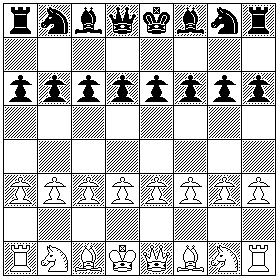
Thai chess, called Makruk, starts with a different initial layout. The pawns do not move two spaces forwards on their first move, since they already start an extra space forwards. The Queen moves only one space diagonally (as a Fers), and the Bishop moves either one space diagonally or one space forwards (as an Elephant).
There is no castling, and of course no en passant capture. Pawns only promote to the Queen/Fers, and they do so on the rank at which the opponent's pawns are initially located, the sixth rank.
Stalemate is a draw. Incidentally, this traditional form of Thai chess continues to be popular throughout Thailand in the present day, and has not been overwhelmed by Western chess.
The Cambodian form of chess, Ok, is almost identical, but with a few added rules.
The King's first move, if it is not in check, can be a Knight's move, one square forwards and two squares to the left or right.
The Queen can move two spaces directly forwards as its first move as well.
These two additional moves were part of chess in Thailand in ancient times, but are no longer part of the game there.
When one player has a bare King, the number of moves the other player has to give checkmate is limited, based on the pieces the other player has available.
Normally, one subtracts the number of pieces on the board from 64 to give the number of moves allowed to give mate. But if no Pawns are left on the board, then the number of moves may be smaller depending on the forces available to the stronger player:
If the stronger player has only Queens, including promoted Pawns, and possibly only one Knight as well, or if there are (unpromoted) Pawns present, the starting point is 64 moves.
A variant of Cambodian chess, called Ka Ok, is won by the first player to give check.
Thai chess also has a variant, Makpong, which is specifically intended as a way to reduce the chance of a draw. Here, giving check is not automatically a win, but the King can't move out of check; a check can only be countered by interposition or by capturing the checking piece. It is used if a match is drawn after a set number of games.
One wonders if this could be applied to the standard Chess game, instead of playing games under faster and faster time controls, as was done in the Carlsen-Caruana match.
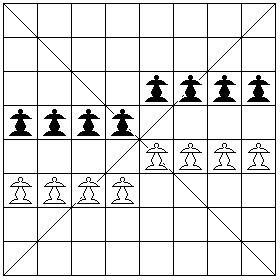
Burmese chess, or Sittuyin, also has the Queen moving only one space diagonally, and the Bishop moving either one space diagonally, or one space forwards.
Its most distinctive feature is that only the initial positions of the Pawns are fixed, the players disposing the other pieces at their own choosing.
In informal play, the players may simply both put their pieces on the board at the same time, or White may first place one piece, and then Black one piece, but in serious play, the official rule is that first White places all his pieces on the board, and then Black proceeds to set up his array, subject to not being allowed, except with the opponent's permission, to place both Rooks in the same column or a Rook in the same column as the opponent's King. Other accounts say that both players place their pieces simultaneously, behind a barrier hiding their choices from view.
Placing one's opponent in stalemate is illegal. Pawns promote when they reach the diagonal lines in the opponent's half of the board, and they only promote to Queens. Another account notes a rule that allows a pawn to avoid promoting when this happens, but gives it the ability to promote, instead of moving, if it is sitting on the diagonal. This account also states that a player may only have one Queen at a time.
Incidentally, the black pieces may be red in color instead, and the white pieces green in color instead.
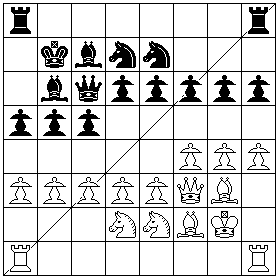
Another account of Burmese chess differs from the one above in some respects.
The piece corresponding to the Bishop can move one space diagonally, or one space forwards, but it can only capture by moving one space diagonally.
The board has only one diagonal, and only the three pawns on each player's right hand can promote (or possibly the four or five rightmost pawns).
Promotion, according to this account, is to any piece, not just to a Queen, so promotion to more powerful pieces, such as Knights and Rooks, is possible.
Also, while the placement of the pieces other than the Pawns is up to each player, the arrangement of pieces shown in the diagram is said to be so popular as to be almost ubiquitous.
However, it appears that this account of Burmese chess, with only three, rather than four, pawns advanced on each side, is simply the result of errors in accounts of the game by early visitors to Burma, rather than corresponding to an alternate form of the game that was also played in earlier times.
As the game of Chess developed in Europe, the two-space first move for the Pawn and Castling, starting from a variety of different rules, reached something close to their modern form first, as well as Pawns being allowed to promote to pieces other than the Fers, with the new moves for the Bishop and the Queen being introduced some time afterwards.
However, in some places, the rule that a Pawn could only promote to a piece if it had been captured, so that an actual physical piece of the right type was available from the chess set, persisted a late as the nineteenth century.
In Iceland, there were a number of unique special rules for Chess. These related to the conclusion of the game.
First, some forms of checkmate were esteemed as more ignominious than others.
There was a term for checkmate by each type of piece:
Of these, only mate by a Pawn was considered shameful.
In addition, however, it was considered ignominious if checkmate took place in certain locations on the board:
The last was considered the worst of those, particularly if the King had never moved.
A special case of mate by a Pawn, peðmát, was when mate was inflicted by the Pawn at the time of its promotion; this was called útkomumát, and it also had special names depending on which Pawn inflicted the mate:
Second, after inflicting checkmate, the game could continue, provided that after each move by the victorious player, the losing player remained checkmated, but was in check from a piece that had not inflicted check previously as part of this series of moves. It was believed that no more than nine such moves were possible.
The first three checkmates so achieved are termed low mates (lág mát), and any remaining checkmates are termed high mates (há mát).
Also, one could win by removing all the opponent's pieces other than the King, the victory known as Bare King; this was normally an inferior form of victory, but not if the move capturing the last such piece also inflicted checkmate; the two cases were known as litla bert and stora bert respectively.
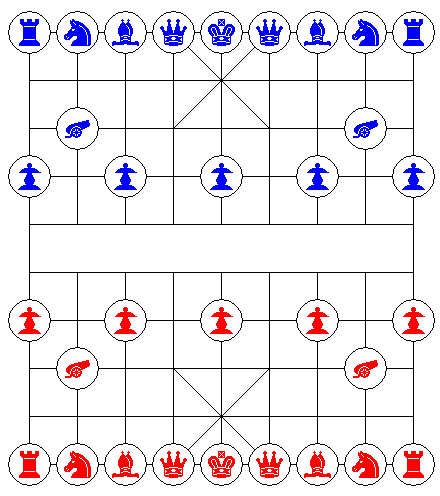
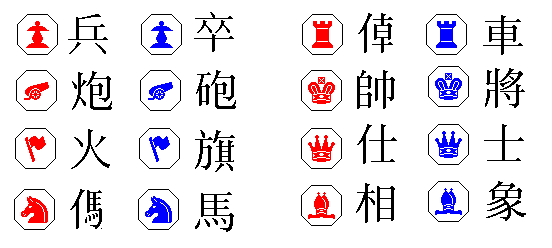
Chinese chess, or Hsiang ch'i (Xiang Qi), is shown using Western chess symbols at right for ease of explanation. As the pieces in actual sets are disks labelled with Chinese characters, a key to those characters appears below:
The Pawn moves, and captures, forwards only until it crosses the middle line of the board, the river, after which it can move and capture sideways as well as forwards. It does not otherwise promote.
The Cannon moves as a Rook, but it captures along Rook lines as follows: it jumps over, without disturbing, the first man of either color on such a line, and then captures the next man on that line which must belong to the opponent.
The Rook (or Chariot) moves as in conventional chess.
The Knight (or Horse) moves almost as in conventional chess, except that its move consists of two steps, first an orthogonal move, and then a diagonal move involving only a 45-degree course change, and so it can be blocked by a piece on the intermediate square.
The piece shown as a Bishop (actually the Minister or Elephant, depending on which side it is on) moves always two squares diagonally, and can be blocked by an intervening piece. It cannot cross the river, but remains on its side of the board. Note that this is the move of the Alfil in Shatranj, except for the fact that it can be blocked by an intervening piece; another source, however, claims the opposite.
The piece shown as a Queen is the Counsellor, and moves one square diagonally; it cannot leave the nine-point area indicated by an X in the center of the back three rows of its own side.
The piece shown as a King is the General; it moves one step orthogonally only, and it, like the Minister, cannot leave the nine-point area indicated by the X. Also, the Generals of the two sides cannot face each other on an open file.
Stalemate is a win for the player that forces it, just as checkmate.
Because there are only five pawns, and they cannot protect each other, this game, although largely having the same pieces as the original Shatranj, the only major exception being the Cannon, is very different from conventional Chess. Bringing the Chariots out early in the game, unwise in conventional Chess, is advisable in this game, for example.
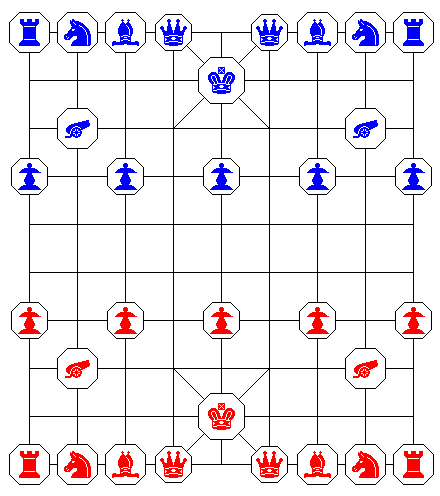
Korean chess, Janggi (also variously transliterated as Jang-gi, Changgi, or Tjyang Keui), is played using the same board and men, except that the Generals are placed one square forwards compared to their initial position in Chinese chess.
In Korean chess, the Cannon (Hpo) jumps over one man to move as well as to capture. In addition, a Cannon is not allowed to capture an enemy Cannon, nor may the piece that it leaps over be a Cannon of either color. And neither player can move his Cannon on his first move.
Also, the Generals (Han/Cho; Jang/Gwan; Gung) and Counsellors (Sa) both have the same move, and follow all the marked lines of the nine-point citadel.
The move of the Elephant (Sjeng) is also different; in Korean chess, it first moves one step orthogonally, and then changes course by 45 degrees to move two steps diagonally. Unlike the Zebra, however, in this course of steps it can be blocked by intervening pieces. (As in Chinese Chess, the Horse moves by an orthogonal step followed by a diagonal step, and can also be blocked by an intervening piece.)
Also, when in the citadel, the Chariot (Tcha) and Pawn (Foot Soldier: Pyeng/Tjol) both gain the power to move diagonally along those marked lines.
As well, when one side has fewer pieces than the other, due to captures, the General is allowed to give check by moving to a file where it faces the opposing General. If this is done, however, the game is at best a draw for the player who gave check in this manner, whether checkmate includes this type of check or that player gives a normal checkmate afterward.
The game is also a draw instead of a win if the piece giving the check in a checkmate is protected from being captured by the General that is being checkmated only by the opposing General, even though doing so is not a departure from the normal rules. But it is reasonable to give a player otherwise checkmated the same privilege of checking the opponent's King with his King that a player down in material has.
Another unusual feature of Korean Chess is that there is no such thing as Zugzwang in the game, as one can flip one's King over to indicate one is forfeiting one's turn, if one does not wish to make any available move. Also, the official rule for promotion is that a pawn can only promote to a captured piece (excluding, of course, a Counsellor).
Also: the player with the Blue (or Green) pieces moves first, but before play starts, the player with the Red pieces gets the first choice to exchange the Horse and the Elephant in his starting layout on one or both sides of the board.
In tournament play, to avoid draws, when a game would otherwise be a draw, the player with a superiority in material wins. This is judged by giving the following point value to each piece:
Counsellor       3
Elephant         3
Horse            5
Chariot         13
Cannon           7
Pawn             2
However, the player with the Red pieces, who is the second one to move, gets an additional 1 1/2 points when the point values of the pieces on each side are counted.
Note that, with the odd half-point to make ties impossible, this is precisely analogous to komidashi as used in the game of Baduk - better known as Go or Wei Ch'i. Which, of course, raises the question of why I didn't think of that when instead going ahead and coming up with Dynamic Scoring for the conventional Western game of Chess.
Of course, I do have an answer: I was only aiming to reduce the number of draws, not eliminate them totally, and so while allowing bare King and even perpetual check as victories, using material superiority as a criterion did not occur to me. Also, in the Western game of Chess, White's advantage of the first move is generally thought to be less valuable than a Pawn, which would imply that a 1/2 point offset rather than a 1 1/2 point offset - if a Pawn counted for one point - would be appropriate.
The Pawn and Counsellor are normally smaller, and the General larger, in a Korean chess set, in which the pieces are usually octagonal; in a Chinese chess set, the pieces are usually all the same size and circular.
In addition, since my goal was to bring about, in effect, a return from the Modern era of Chess to the more flamboyant Romantic era of Chess, with its gambits and impressive sacrifices, providing a victory based on material superiority would seem, at first glance, to be going in the opposite direction from my goal. But since each level of victory is only worth a small fraction of the value of the victory on the next higher level (stalemate = 1/5 of checkmate, bare King = 1/5 of stalemate, perpetual check = 1/5 of bare King, material superiority = 1/4 of perpetual check) the danger appears illusory, while the goal of avoiding the situation where White plays more defensively instead of less defensively, preferring the neutral draw to the lesser victories in which he is at the greatest disadvantage, instead of playing more aggressively to aim at the greater victories in which his disadvantage is lessened, is furthered by making draws nearly impossible except by agreement.
The changed move for the Minister or Elephant in Korean chess is a distinct improvement on the move for that piece in Chinese chess, as that piece can now reach any square on the board. On the other hand, the Cannon and General in Chinese chess seem, at least to me, to make more sense.
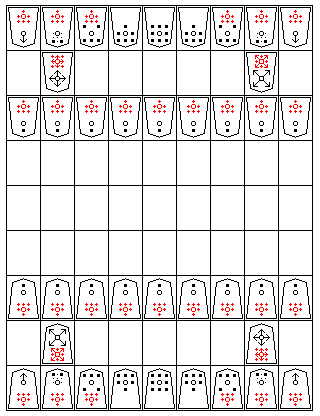
Japanese chess, or Shogi, has as its main distinguishing feature the fact that captured pieces may be re-introduced on the board by the capturer. This feature is a relatively recent one, and was not present on the older versions of Shogi, such as Tsiu Shogi, played on a 12x12 board, or the other, larger versions, whose rules were once thought to have been lost, but which were recently rediscovered.
Re-entering a captured piece on the board counts as a move; a drop is expected to be an attacking move. Promoted pieces are re-entered in their unpromoted form. A Pawn may not be re-entered on a file containing one of one's own Pawns, and pieces that move only forwards cannot be re-entered in a position so advanced that they would be unable to move.
Also, while a dropped Pawn can give check, the drop of a Pawn cannot be the move that administers checkmate. This restriction does not apply to the drop of any other piece. Also, there is no restriction on blocking a check through interposition by means of a drop, and thus checkmate is often given by a protected piece adjacent to the King, since rendering it unprotected may relieve the mate but not the check, so the King would still be liable to capture on the next move.
Except for the King and the Gold General, all the pieces promote when they reach the last three rows of the board. Promotion is optional, except when the unpromoted piece would no longer be able to move, and can take place on any move that ends with the piece involved on the last three rows. The pieces are shown with their moves illustrated on them, and with the moves of their promoted forms in red below them.
The third row of pieces each player has consists of nine pawns; pawns promote to Gold General.
The second row consists of a Bishop on the player's left, and a Rook on the player's right. The Bishop promotes to Dragon Horse and the Rook to Dragon King, in each case adding the ability to move one square in the direction opposite to the normal movement of the piece.
The first row consists of Pikeman, Horse, Silver General, Gold General, King, Gold General, Silver General, Horse, and Pikeman.
Except for the King and the Gold General, all these pieces promote, and they promote to the Gold General.
The Pikeman can only move forwards on its file.
The Horse moves like a Knight, but can only make its two forwardmost moves.
The Silver General moves one space diagonally, or one space forwards.
The Gold General moves one space in any direction except diagonally backwards.
The King moves one space in any direction.
As with Chinese chess, the fact that the Pawns capture as they move changes the character of the game considerably from that of the conventional game of Chess; the ability to re-enter captured pieces changes it still further.
The immediate predecessor of the modern game of Shogi was Sho Shogi. In that game, there was one additional piece on the board, a Drunk Elephant, which was in the middle of the second row.
It could move in any direction except directly backwards; it promoted to a Crown Prince, which not only had the same move as the King, but which also had to be captured, in addition to the King, to defeat the side with a Crown Prince. In this form of the game, captured pieces were not returned to the board.