In this section, we have been examining various ways in which computers could be devised which were capable of handling data which came in units of several different lengths.
However, each of these alternatives came with some added degree of cost and complexity, and it seems not only possible but likely that there is not enough interest in having the additional floating-point precision choices advocated here for very many people to be willing to put up with that.
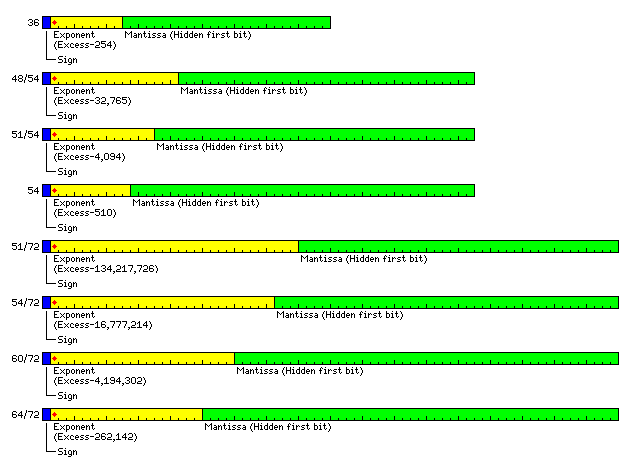
Thus, on the first page of this section, I recently added a set of floating-point formats like these, but shown here more completely:
which were designed for a computer with a 36-bit word length and a 9-bit byte. Although the byte was now one bit longer, the data types would all be power-of-two multiples of that 9-bit byte.
While all of today's microprocessors are built around the 8-bit byte, I'm not aware of any current architectures that offer bit addressing, which is really the only thing that gets lost when the byte no longer contains a power-of-two number of bits.
Thus, a computer based on a 36-bit word and a 9-bit byte which has data types built on power-of-two multiples of the byte would not really differ much from today's conventional microprocessors, so it wouldn't do violence to the habits of thought of their users.
The ideal 36-bit single-precision type which was one of my goals is provided directly.
For greater acceptance, the double-precision type retains the full precision of conventional 64-bit double-precision floats, even though I felt a 60-bit double-precision float was fully adequate. The extra bits provided by the 72-bit storage cell are all added to the exponent field. This avoids slowing down floating-point arithmetic in order to provide un-needed precision, and it makes it easier to perform extensive calculations without exponent overflow or loss of precision.
While a 36-bit computer would be perfectly capable of handling 54-bit floats aligned on 18-bit boundaries, I showed how a 54-bit float could similarly be expanded to 72 bits so as to maximize speed and convenience in transferring such values to and from memory.
After proposing this possibility, I considered the fact that even with a design intended to closely resemble the conventional 8-bit-centric computer, even if it found a market, it still wouldn't take over from conventional computers; instead, even if the 9-bit byte existed as an alternative, the 8-bit byte would still be dominant and pervasive.
How could this type of computer be made able to efficiently interoperate with conventional processors?
It seemed to me that the best approach would be to have these data types:
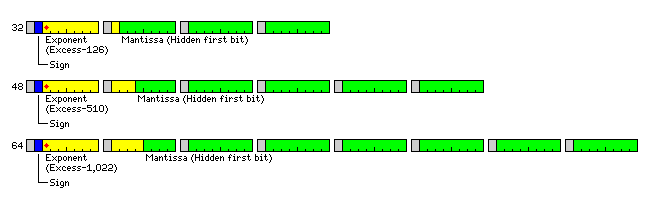
which match those used in a system oriented around the 8-bit byte, and occupy only the eight least significant bits of each 9-bit byte within the system with a 36-bit word.
These would be stored normally within registers, so that conversion to and from these types would be automatic. Either a conventional microprocessor could be connected to the same bus as one with a 36-bit word, skipping the most significant bit of each group of nine, or these types would allow a system with a conventional microprocessor to read data from an input-output medium oriented around character-sized units... which the 36-bit word machine had written to one 9-bit byte at a time. This would also work for character-oriented telecommunications.
In addition to data types which use only eight bits per nine-bit byte, an additional set could be added which use only six bits per nine-bit byte, as shown below:
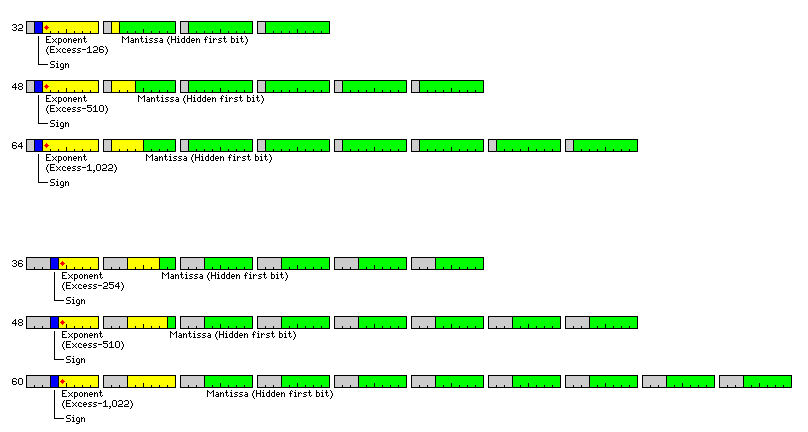
This would allow connecting a processor with a 48-bit word, or saving data on media such as 7-track tape (of course, with odd parity, not even, so that binary data could be saved).
In addition to floating-point formats which use only part of each nine-bit byte, similar integer formats would also be required. Particularly useful would be ones that take a 72-bit long integer, and saves it either as nine bytes with eight bits of data in each of them, or as twelve bytes with six bits of data in each of them. That would permit the primary processor with a 36-bit word to save swapped-out pages to a disk drive designed to work with computers within the 8-bit world, for example.